Table of Contents
The Capital Allocation Question: The Decision That Determines Every Other Decision
Every growing business reaches the point where there are more good opportunities than there is money, time, or attention to pursue them.
That’s when capital allocation becomes one of the most important jobs we have.
The problem is that we rarely think about it that way. We approve a marketing budget because marketing seems important. We buy software because operations feel messy. We hire because everyone feels stretched. Every one of those decisions can be justified on its own.
But capital never exists in isolation.
Every dollar committed to one project is a dollar that cannot be used somewhere else. Every hour your team spends solving one problem is an hour they cannot spend solving another. Once we start looking at decisions that way, the conversation changes.
The Capital Allocation Question
The question is simple.
Is this the highest-return use of the available capital?
That sounds like a small change in wording, but it changes how we evaluate almost every decision inside a business.
Most investments are reasonable. That isn’t the issue.
The issue is whether this investment produces a better return than every other available use of the same capital.
Before increasing your marketing budget, compare it against every other opportunity that same money could support.
Before investing in technology, ask whether solving a different operational problem would create a larger return.
Before hiring another employee, determine whether a different role would remove a bigger bottleneck.
The comparison matters more than the individual decision.
That is why disciplined investors consistently allocate resources better than businesses that simply react to whatever feels most urgent. Urgency is a poor substitute for prioritization. It tells us which problem is making the most noise today. It tells us nothing about which investment produces the greatest return.
The Capital Allocation Matrix
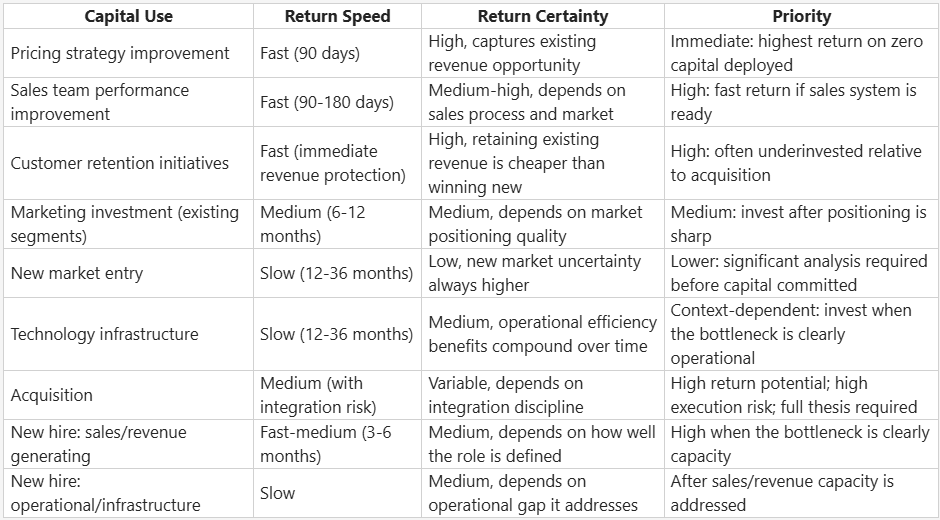
One useful way to think about capital allocation is through two questions.
How quickly will this investment produce a return?
How certain is that return?
Those two variables create a practical way to prioritize investments instead of relying on instinct.
Some decisions produce returns quickly and with a high degree of certainty. Others require more time, more analysis, and a greater willingness to accept uncertainty. Looking at both dimensions together helps determine not only where capital belongs, but also the sequence in which it should be deployed.
Some Investments Move Faster Than Others
Pricing strategy improvement sits near the top of the list.
It can produce a return in roughly ninety days, captures revenue that already exists inside the business, and requires no additional capital deployment. Few investments produce that combination of speed and certainty.
Sales team performance improvement also produces relatively fast returns when the sales system is already capable of converting opportunities. The outcome still depends on execution and the market, but the return can appear within ninety to one hundred eighty days.
Customer retention deserves more attention than it often receives.
Keeping existing revenue is less expensive than replacing it. Even so, many businesses continue directing disproportionate resources toward acquisition while underinvesting in retention.
That sequence matters.
Some Investments Require More Patience
Marketing into existing customer segments generally takes longer. Returns often appear over six to twelve months and depend heavily on clear market positioning.
New market entry requires even more patience.
New markets introduce uncertainty by definition, which means they deserve more analysis before meaningful capital is committed. Returns may take twelve to thirty-six months to appear.
Technology infrastructure follows a similar pattern.
The operational benefits often compound over time, but the investment becomes much more compelling when the constraint is clearly operational instead of simply inconvenient.
Acquisitions also deserve careful treatment.
They have the potential to produce significant returns, but integration determines whether that potential becomes reality. A complete investment thesis should exist before capital is committed because execution risk remains high.
Hiring Is Also a Capital Allocation Decision
We often think about hiring as a staffing decision.
It is a capital allocation decision.
A revenue-generating hire can begin producing returns within three to six months when the business has a clearly defined sales constraint and the role has been designed well.
Operational hires serve an important purpose too, but they generally produce stronger returns after revenue-generating capacity has already been addressed.
The sequence matters because every hire competes with every other possible use of that capital.
Better Questions Produce Better Decisions
Most businesses don’t struggle because they lack opportunities.
They struggle because every opportunity looks worthwhile when it is evaluated by itself.
Capital allocation forces every investment to compete against every alternative.
That changes the conversation from, “Is this a good idea?” to, “Is this the best use of the resources we have available right now?”
Those are different questions.
One produces activity.
The other determines how much value your capital is capable of producing.