Table of Contents
A lot of businesses don’t have a strategy problem. They have an Operating Cadence problem.
We spend days building the annual plan. We debate priorities. We decide where the money should go. We leave the planning meeting convinced we’re finally aligned.
Then everyone goes back to work.
A few months later, the business is busy again, but nobody is quite sure whether the work being done still matches the plan we agreed to. The strategy hasn’t necessarily failed. It simply stopped showing up in the decisions we made every day.
Execution works differently than most of us expect. We tend to think it comes from making better decisions once. In reality, it comes from reviewing those decisions over and over again on a schedule that forces us to adjust before small problems become expensive ones.
That is what an Operating Cadence does.
Your Operating Cadence Keeps Strategy Alive
Strategy is not something you create once a year. It has to survive hundreds of decisions between planning sessions.
Without a structured review process, the business naturally drifts toward whatever feels most urgent today. We have all experienced it. Customer issues appear. Sales fluctuate. Hiring takes longer than expected. Cash gets tighter than we planned. None of those decisions are necessarily wrong, but they slowly pull the company away from the direction we originally chose.
An Operating Cadence gives us scheduled moments to stop reacting and start evaluating again.
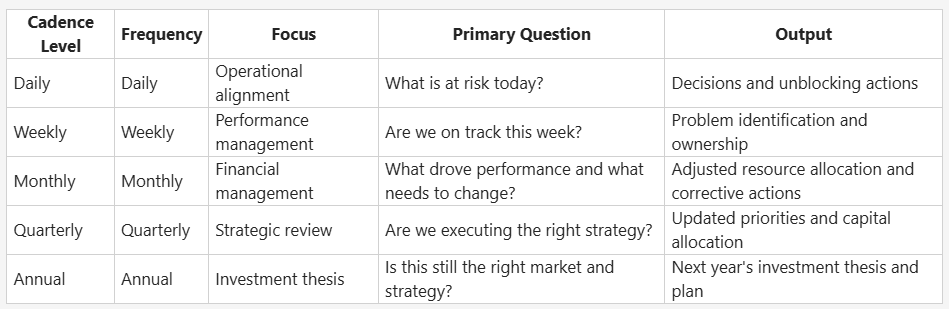
Each review serves a different purpose. Together, they connect today’s work with the long-term direction of the business.
Daily Operating Cadence: Solve Today’s Problems
The daily review is about operations.
It is not a strategy session.
Its purpose is simple. Identify what is at risk today, decide what needs attention, and remove anything preventing work from moving forward.
Some businesses accomplish this with a short stand-up meeting. Others do it through a morning email. The format is far less important than the outcome.
We are creating alignment around today’s work so people can make progress without unnecessary delays.
Weekly Operating Cadence: Measure Performance Before Problems Grow
Many owners wait until month-end financials arrive before asking whether things are on track.
By then, the business has already spent four weeks moving in one direction.
A weekly review shortens that feedback loop.
This is where we compare operational performance against the targets we already established. Revenue. Pipeline. Utilisation. Customer satisfaction. Cash.
Those numbers tell us whether the business is moving where we intended or whether something needs attention while it is still manageable.
Just as important, the weekly review creates ownership. Problems are identified, someone becomes responsible for solving them, and progress is reviewed again the following week.
Monthly Operating Cadence: Understand Financial Performance
The monthly review goes deeper.
Instead of asking whether we stayed on pace this week, we ask what actually drove financial performance over the past month.
We compare results against budget. We review progress toward strategic milestones. We determine what changed and what needs to change next.
That discussion leads directly to resource allocation and corrective action.
Most owners look at financial reports as scoreboards.
The better approach is to treat them as decision tools. Financial performance tells us whether our assumptions are proving correct. If they are not, the monthly review gives us the opportunity to adjust before another month passes.
Quarterly Operating Cadence: Make Sure You’re Executing the Right Strategy
The quarterly review is the most important meeting on the calendar.
This is where we step back from day-to-day operations and evaluate the strategy itself.
Are we executing the strategy we committed to?
Do the assumptions we made about the market still hold?
Do our priorities still deserve the same resources they received three months ago?
Those questions matter because execution is not simply doing what we planned. Execution also requires confirming that the plan still deserves to be executed.
Sometimes the answer is yes.
Sometimes the market changes.
Sometimes our assumptions prove incomplete.
The quarterly review gives us a disciplined point to make those decisions rather than allowing circumstances to make them for us.
Annual Operating Cadence: Start With the Investment Thesis
Everything begins with the annual planning cycle.
This is where we establish the investment thesis for the coming year, decide our strategic priorities, and allocate capital.
Every review that follows exists because of the decisions made here.
The daily review keeps operations moving.
The weekly review measures progress.
The monthly review explains financial performance.
The quarterly review evaluates strategy.
Each one builds on the previous review until the annual planning cycle begins again.
That rhythm is what keeps execution connected to the business we are actually trying to build.
Too many owners think execution depends on working harder. It usually depends on reviewing better.
Without an Operating Cadence, the annual plan slowly becomes a document sitting on a shelf while the business follows whatever feels urgent that week.
With an Operating Cadence, every review creates another opportunity to compare today’s decisions against the future we said we wanted to build.
Over time, those reviews shape the company far more than a single planning meeting ever will. They determine whether the strategy stays active or slowly disappears beneath the weight of daily work.
The businesses that keep reviewing, adjusting, and making decisions on purpose are capable of producing consistent execution year after year.