
Table of Contents
Three years ago, AI barely showed up in the strategic plans of founder-led businesses.
That has changed.
If we are building an annual plan today, AI strategic planning belongs in the conversation alongside market size, competitive position, and unit economics. We have to look at what AI is doing to our specific business, what it is doing to the market around us, and where that should change the way we allocate capital.
A lot of owners will approach AI primarily as a technology decision. Which tools should we buy? What can we automate? How much time can we save?
Those questions matter, but they do not go far enough.
The bigger issue is whether AI is making the business more valuable, making parts of the business easier to replace, or doing both at the same time.
That is what belongs in the strategic plan.
Why AI Strategic Planning Has to Be Annual
The difficult part of writing about AI is that the specific capabilities will keep changing.
Eighteen months from now, the tools, economics, and competitive landscape may look materially different from what we see today. That does not make the planning discipline temporary.
The durable parts of the ACE framework still hold. We still need market sizing principles. We still need capital allocation sequencing. We still need execution discipline and a planning cycle that forces us to revisit the assumptions underneath the plan.
AI simply gives us another variable that needs to be reviewed inside that process.
So when we do AI strategic planning, we should expect the answers to change. That is why the AI market review belongs in the annual planning cycle.
AI Strategic Planning Starts With Two Separate Questions
We need to look at AI from two directions.
First, how much does AI threaten the way we currently make money?
Second, where can AI improve our competitive position?
It is easy to assume those questions lead to the same answer. They do not.
You may have a service line where AI can now perform work that previously required people. At the same time, you may have an operating function where AI can reduce cost, increase speed, or improve quality.
The threat can be real while the opportunity is also real.
We have to evaluate both.
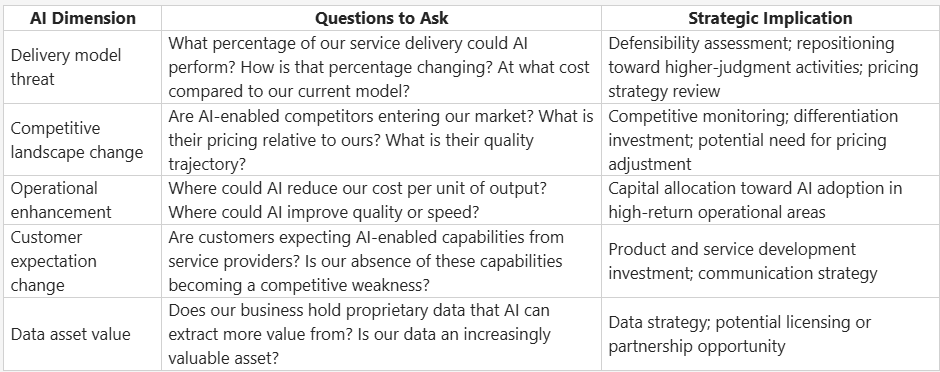
Start with the delivery model. What percentage of the service could AI perform? How is that percentage changing? What does the cost look like compared with the way the work gets done today?
If AI can increasingly perform the work itself, we have to look harder at defensibility, higher-judgment activities, and pricing.
Then look at the competitive landscape. Are AI-enabled competitors entering the market? What are they charging? Is their quality improving?
That matters because an efficiency advantage is only an advantage when competitors cannot easily reproduce it.
Efficiency Does Not Automatically Create an Advantage
There is a content marketing agency example that makes this painfully clear.
The founder had adopted several AI tools and could now produce content at 60% of the previous cost.
That sounds like progress.
And operationally, it was.
But every other agency could use similar tools, including agencies that were already competing on price. The founder had become more efficient without necessarily becoming more defensible.
Her stronger advantage was deep sector expertise in a highly regulated industry.
That was harder for AI to replicate.
The problem was that the production efficiency had received attention while the harder-to-replicate expertise had not received the same protection.
We can make the same mistake in almost any business. We see a tool that reduces cost and assume we have strengthened the company. Sometimes all we have done is adopt an efficiency that the rest of the market can adopt too.
That is why AI strategic planning has to go beyond adoption.
Look at the Five Places AI Can Change the Business
The strategic review needs to cover five areas.
We have already looked at the delivery model and the competitive landscape. Then we need to look at operational enhancement. Where can AI reduce cost per unit of output? Where can it improve quality or speed?
Next comes customer expectation. Are customers beginning to expect AI-enabled capabilities from the businesses they hire? If we do not provide them, is that becoming a weakness?
Then look at the data we already own. Does the business have proprietary data from which AI can extract more value? Is that data becoming more strategically important? Could it create licensing or partnership opportunities?
These questions tell us more than whether the company is “using AI.”
They tell us how AI is changing the position of the company.
Move More of the Business Toward What AI Cannot Easily Replace
Most businesses are going to sit somewhere on a spectrum.
On one end, AI protects or enhances value because it improves efficiency or because the company’s advantage rests on things AI has difficulty replicating. Proprietary data. Genuine expertise. Trusted relationships. Regulatory positioning.
On the other end, AI threatens value because the business depends on people performing tasks AI can increasingly perform, pricing based on scarcity AI eliminates, or a customer experience that can be recreated digitally at a fraction of the cost.
Most of us will have pieces of both.
The important question is which direction the company is moving.
That is where capital allocation enters the conversation.
AI Strategic Planning Is Also Capital Allocation
Once we understand the threat and opportunity, we have to decide where money should go.
Some capital needs to protect the business.
If AI threatens the delivery model, we should be strengthening the parts of the company that are hardest to replicate: practitioner expertise, proprietary methodologies, deep client trust, regulated professional credentials, and community or network effects.
Other capital can go toward opportunity.
Where can AI create faster service delivery? Higher quality at lower cost? More capacity without adding headcount?
We should evaluate those investments the same way we would evaluate any other capital allocation decision. What does the tool cost, and what is it capable of producing inside the operating model?
There is also a baseline we should stop treating as strategy.
Every business should be systematically adopting AI inside operational and administrative functions. If we are not using it to improve team efficiency, we are already falling behind the efficiency curve.
That adoption matters. It just does not answer the larger strategic question.
The expensive mistake is getting better and cheaper at the part of the business everyone else can now copy while underinvesting in the expertise, data, trust, credentials, methodologies, or network effects that still make the company difficult to replace.