Table of Contents
A lot of companies start their annual planning cycle by opening a spreadsheet.
What did we do last year?
What should revenue be next year?
What can we afford to spend?
Then, somewhere inside that process, we call it strategy.
I think we have that backwards.
The numbers matter. Obviously. But the budget should be the financial expression of the strategy. It shouldn’t be the thing that determines the strategy in the first place.
If we’re trying to build a company that becomes more valuable over time, the annual planning cycle needs to start much earlier and with a different question:
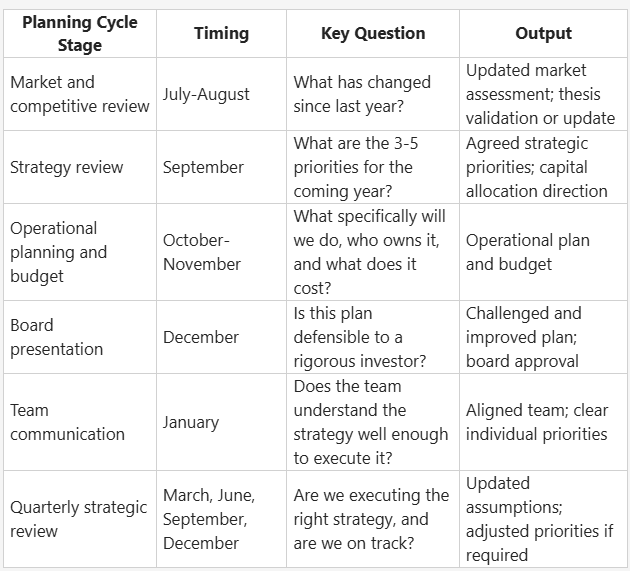
July and August: Start the Annual Planning Cycle With the Market
Before we start setting targets, we need to understand the environment we’re operating in.
What has changed in customer behavior? What are competitors doing differently? Is technology changing how the market works? Have regulatory or economic conditions shifted? Where did we outperform the market, and where did we fall behind it?
This shouldn’t just be a conversation around a conference table.
The goal is a short written market assessment, maybe a page or two, that forces us to update the investment thesis based on what we now know.
There’s a big difference between saying, “I feel pretty good about where the market is going,” and putting the assumptions on paper.
Founders spend years developing instincts about their industries, and those instincts are valuable. But an investor doesn’t stop at instinct. An investor wants to know whether the original thesis still holds.
That’s the first shift.
The annual planning cycle doesn’t begin with what we want the company to do next year. It begins with what the evidence says has changed since last year.
September: Decide What Actually Matters
September is where the real strategy conversation happens.
Given what we now know, what are the three to five things that matter most next year?
I worked with one management team that resisted creating this meeting for almost a year. Their calendar was always full. There was always something more urgent.
Eventually, they held it.
Afterward, the founder told me it was the first time in six years that he had sat with his senior team and talked about the business without looking at a spreadsheet.
Three hours.
They talked about what was happening in the market and what they should do about it.
By the end of the conversation, they had removed two initiatives that had been consuming resources for 18 months. They also identified a priority none of them had individually connected to the strategy before sitting down together.
That is what the strategy review is supposed to do.
We tend to combine this conversation with budgeting because it feels efficient. But once the budget enters the room, the question subtly changes.
Instead of asking, “What should we do?”
We start asking, “What can we afford?”
Those are not the same question.
Strategy decides where capital should go. The budget determines how that capital gets deployed.
When we reverse that order, affordability starts driving direction.
October and November: Make the Budget Follow the Strategy
Once the priorities are clear, we can finally build the operating plan.
For each priority, we need to know what will actually happen, who owns it, how long it should take, what it will cost, and what return we expect.
Now the budget starts to mean something.
Instead of setting a revenue target at the top and forcing the rest of the organization to reverse-engineer a plan to hit it, we’re building the budget from the strategic priorities upward.
That makes the numbers more credible because the spending has a reason behind it.
There is a specific intention attached to the capital.
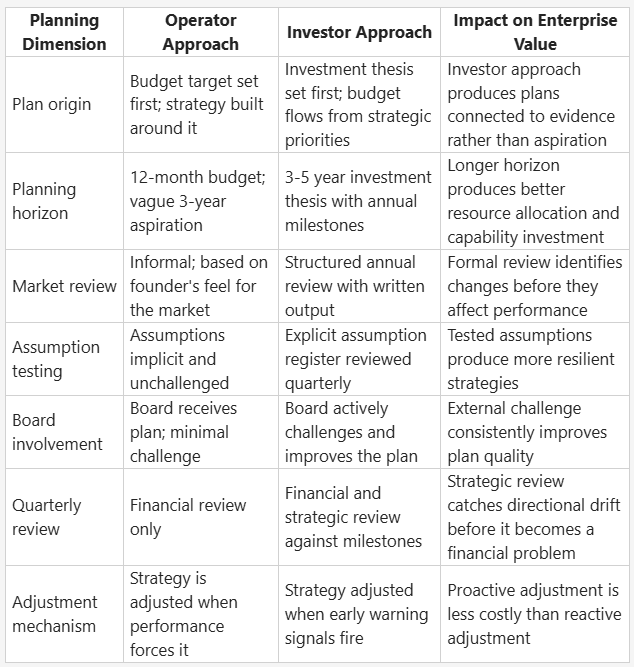
This is one of the clearest differences between an operator’s annual planning cycle and an investor’s.
The operator tends to start with the 12-month budget and build the plan around it.
The investor starts with the thesis, decides what must happen to advance it, and then allocates the resources necessary to execute.
That sounds like a small sequencing difference.
It isn’t.
It changes what gets funded.
December: Make Someone Challenge the Plan
By December, the plan should be ready for the board.
But the board’s job isn’t to admire it.
It’s to challenge it.
Is the market analysis sound? Are the assumptions defensible? Is the company putting capital toward its highest-return opportunities? Does the execution system actually exist to turn the plan into results?
A management team that knows it will have to defend its thinking tends to think harder before walking into the room.
That’s healthy.
The annual planning cycle gets weaker when approval is automatic. We should want somebody outside the day-to-day operation asking whether this is actually the best use of the company’s resources.
If we’re serious about thinking like investors, the plan should be able to survive an investment committee-level challenge.
January: Make Sure the Team Understands the Why
Then we communicate.
Not every detail needs to be pushed through the organization, but people need to understand the strategic priorities, the key targets, and how their work connects to what the company is trying to accomplish.
Because plans don’t usually break when someone is staring directly at them.
They break in the hundreds of small decisions made throughout the year.
A client asks for something just outside the normal service model.
A good hiring opportunity appears unexpectedly.
The market shifts.
Someone has to make a judgment call.
The person who understands the strategy can make that decision in context. The person who only knows their task list can’t.
That matters more than we sometimes realize.
Quarterly: Keep the Annual Planning Cycle Alive
This may be the most overlooked part.
The plan can’t disappear into a folder after January.
Every quarter, we need two or three hours to look at strategic milestones, test whether our assumptions still hold, revisit capital allocation if necessary, and adjust priorities when conditions change.
Most quarterly reviews turn into financial reviews.
Revenue. Margin. Cash. Forecast.
We need that.
But that’s only half the job.
The other question is harder:
Are we still executing the right strategy?
Financial results usually tell us what already happened. A real strategic review is trying to catch directional drift before it becomes a financial problem.
That’s the investor lens.
Operators adjust when performance forces their hand.
Investors are trying to see the signal earlier.
And that may be the biggest reason to build the annual planning cycle this way.
We’re not planning simply to create a more organized year.
We’re trying to make better decisions about where the company’s money, people, and attention go. We’re testing whether the thesis still works. We’re building the habit of allocating resources based on evidence instead of urgency.
Because eventually, the question becomes bigger than whether we hit next year’s budget.
It’s whether the company we’re building becomes more valuable, more resilient, and less dependent on the founder having to see every problem before everyone else does.
That’s the shift from running the year to building the asset.