
Table of Contents
You can have a revenue target. An EBITDA goal. A hiring plan. A bigger marketing budget.
And still have no idea whether any of it is capable of producing the outcome you want.
That’s the problem Unit Economics solves.
I reviewed a strategic plan for a security installation business that wanted to grow EBITDA from $680,000 to $2 million over three years. The plan was thoughtful. It outlined strategic initiatives, added headcount, increased marketing, and described where the company wanted to go.
What it never did was calculate what actually had to happen for that goal to become reality.
When I ran the numbers, the problem became obvious. The marketing budget wasn’t capable of generating enough new client contracts to reach the EBITDA target. The company knew where it wanted to end up. It just hadn’t done the math to determine whether its plan could actually get it there.
That is exactly what Unit Economics is designed to do.
Unit Economics turns strategy into numbers
We spend a lot of time talking about strategy.
We talk about entering new markets, hiring salespeople, improving operations, raising prices, and growing revenue. Those conversations matter. But eventually every strategy has to become mathematics.
If it doesn’t, we’re simply describing what we hope happens.
Unit Economics starts with the financial outcome you’re trying to achieve and works backward through every operating input required to produce it.
In the PE Guide to M&A, the starting point is your wealth analysis. Suppose that analysis shows your business needs to produce $3.75 million of EBITDA in five years to close your wealth gap.
Now the strategy has a destination.
The next step is determining whether the business you’re building is actually capable of producing it.
Work backward from the financial target
This is where most planning breaks down.
Owners often begin with activities. They hire another salesperson. Increase marketing. Launch another service. Those may all be good decisions, but they come before anyone has determined whether they’re enough.
Unit Economics flips that process around.
Start with the destination.
Producing $3.75 million of EBITDA at a 25% margin requires $15 million of revenue.
Generating $15 million of revenue with an average client value of $75,000 requires 200 active clients.
Maintaining 200 active clients with a 15% annual churn rate requires replacing the clients who leave every year while continuing to grow.
Growing from 80 clients to 200 over five years means adding a net 120 clients, or about 24 each year.
If your conversion rate is 25%, those 24 new clients require 96 qualified opportunities every year.
If each qualified opportunity costs $1,500 to generate, your marketing and sales budget needs to be approximately $144,000 annually.
None of those numbers exist independently.
Each one is produced by the assumption before it.
That matters because changing one assumption changes everything that follows.
Unit Economics exposes where the real work is
This is where strategy becomes useful.
We can compare our current performance with the performance required to reach the financial target.
Are we attracting clients with enough lifetime value?
Is our churn low enough?
Can our current sales process generate enough qualified opportunities?
Does our pricing support the margins we need?
Is our marketing budget large enough to produce the pipeline the strategy requires?
Those comparisons show us exactly where the business falls short.
They also tell us where capital, management attention, and operational effort should be invested first.
The framework doesn’t write the strategy.
It tells us which levers actually have to move.
The Unit Economics framework
A simple Unit Economics model makes every assumption visible.
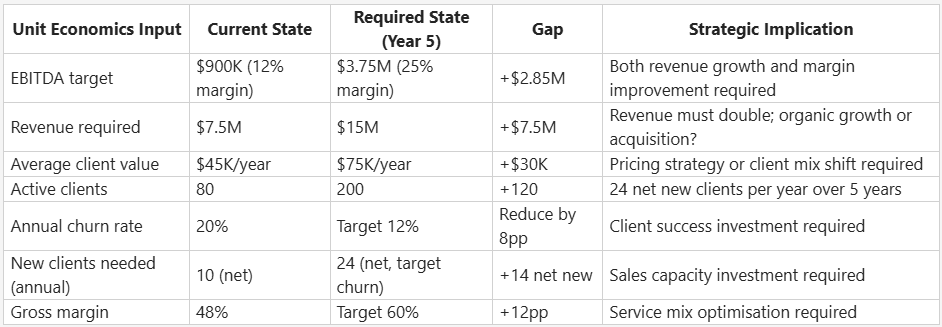
When you lay the numbers out this way, every assumption becomes testable.
You can compare where you are today with where you need to be five years from now.
More importantly, you can see which assumptions are realistic and which ones require a different strategy altogether.
Aspirations don’t produce results. Operating inputs do.
We all like ambitious goals.
Double revenue.
Triple EBITDA.
Grow into a larger market.
There’s nothing wrong with those objectives. The problem comes when the goal becomes the strategy.
Saying you want to double revenue doesn’t explain how that happens.
Calculating that you need 24 net new clients each year, which requires 96 qualified opportunities, which requires a marketing investment of roughly $144,000 at your current conversion rate, does.
That’s the difference between a destination and a route.
Every strategy eventually reaches a point where opinions stop mattering and mathematics takes over.
That’s where Unit Economics earns its place.
Because wealth isn’t built by writing bigger goals on a strategic plan.
It’s built by building a business that is actually capable of producing them.